How to Optimize Content for AI Search Overviews: The 7-Step Playbook (2026)
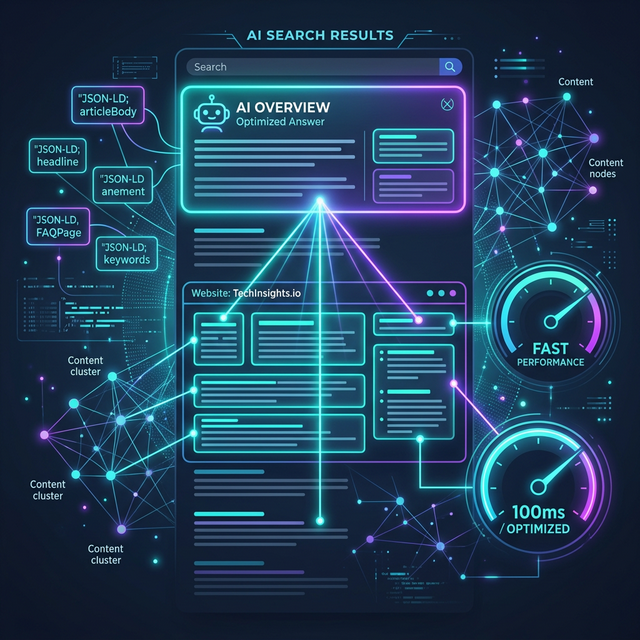
TL;DR: AI Overviews crushed organic click-through rates by 58% — and the pages they cite don't even need to rank #1 anymore. The 7-step playbook: answer-first content blocks, layered schema markup, content clusters, entity-loaded intros, fast page speed, AI crawler access, and relentless freshness. Here's exactly how to get cited instead of buried.
Key Facts:
- Organic CTR dropped 58% on queries where AI Overviews appear — and even queries without AI Overviews lost 41% of clicks year-over-year
- Only 17-38% of pages cited in AI Overviews also rank in the top 10 organic results — traditional rankings no longer guarantee AI visibility
- 65% of pages cited by Google AI Overviews include structured data markup — a 73% selection boost over pages without it
- Pages getting cited earn 35% more organic clicks than uncited pages — AI citation is now the highest-value visibility signal
- 76.4% of ChatGPT's most-cited pages were updated within the last 30 days — freshness is a citation eligibility gate, not a bonus
The Problem: Your Content Ranks on Google but AI Ignores It
You wrote the guide. You earned the backlinks. You rank on page one for your target keyword. And then Google shows an AI Overview at the top of the results page — citing three competitors and zero of your content.
This is the new reality of search in 2026. AI Overviews appear on nearly half of all Google searches, and they're stealing clicks at scale. The old playbook — rank higher, write longer, build more links — doesn't fix this. Because AI Overviews don't pick sources the same way Google ranks pages.
The gap between "ranking on Google" and "getting cited by AI" is where most founders lose traffic they never see drop. You can't fix what you don't measure. And most analytics dashboards don't even show you whether AI is recommending your competitor instead of you.
Here's the good news: the pages that do get cited earn 35% more organic clicks than uncited pages. AI citation isn't just a new metric — it's the highest-value visibility signal in 2026. And the optimization playbook is learnable.
Why AI Overviews Pick Some Pages and Skip Yours
AI Overviews don't just regurgitate the highest-ranking results. Google's Gemini model retrieves information from a much wider range of sources, replacing approximately 42% of previously cited domains in recent updates. The new model delivers 32% more source URLs per response — meaning any single domain's citation share is mathematically smaller.
Three factors determine whether your content gets extracted:
| Factor | What AI Systems Look For | Why It Matters |
|---|---|---|
| Extractability | Self-contained answer blocks (40-60 words) that can stand alone | AI extracts chunks, not whole articles |
| Verifiability | Structured data, clear authorship, cited sources | AI needs confidence signals before citing |
| Comprehensiveness | Topic clusters linking related content | AI trusts domains that demonstrate topical authority |
Traditional SEO treated content as a single ranking unit. AI systems treat it as a collection of extractable statements — each independently evaluated for relevance, accuracy, and citability. This is why a 5,000-word guide with no structure can lose to a 1,000-word page with clean answer blocks and proper schema.
The 7-Step Playbook to Get Cited by AI Overviews
Step 1: Write Answer-First Content Blocks
Every section of your content should lead with a 40-60 word direct answer that can stand alone even if separated from context. This is the single highest-impact change you can make.
AI systems don't read your content top-to-bottom like humans. They extract and rank small, discrete chunks based on relevance to the user's query. Averi's optimization research found that effective AI-optimized content includes three structural elements:
- Hierarchical headings that signal topic relationships
- Direct answers within the first 60 words of each section
- Statistics with clear attribution that provide extractable claims
❌ What most people write:
"Many people wonder about optimizing for AI search. The landscape has changed significantly. There are several factors to consider..."
✅ What gets cited:
"AI search optimization requires three components: answer-first content structure with 40-60 word blocks, layered Schema.org markup (FAQ + Article + HowTo), and content clusters with 3-5 internal links per 1,000 words."
The second version is immediately extractable. The first version forces the AI to synthesize meaning across vague sentences — and it won't bother when better-structured content exists. According to Ahrefs' analysis of 174,000 cited pages, word count has a near-zero correlation (0.04 Spearman) with citation frequency. Structure beats length every time.
Step 2: Implement Layered Schema Markup
Structured data has evolved from a nice-to-have to a citation prerequisite. 65% of pages cited by Google AI Overviews include schema markup — and one controlled experiment proved it directly affects citation.
Search Engine Land researchers created three identical pages differing only in schema implementation:
| Page | Schema Quality | Result |
|---|---|---|
| Page A | Well-implemented | ✅ Appeared in AI Overview, ranked position 3 |
| Page B | Poorly implemented | ❌ Never appeared in AI Overview, peaked at position 8 |
| Page C | No schema | ❌ Never indexed at all |
The three schema types that matter most for blog content:
FAQ Schema (FAQPage) — Highest citation probability. Structures question-answer pairs in the exact format AI systems present information. Match question text to visible H2/H3 headings on the page.
Article Schema (BlogPosting) — Establishes authorship, publication date, and organization. Include author.sameAs with at least 2 external profile URLs (LinkedIn, Twitter) for E-E-A-T verification.
HowTo Schema — Essential for process-based content. Each step becomes an independently extractable answer block that AI can cite for specific "how to" queries.
Layer all three on a single page. This creates redundancy — multiple verification points for AI systems to confirm your content's authority.
Step 3: Build Content Clusters, Not Isolated Posts
Isolated articles compete for citations on their own. Content clusters compete as a domain-wide authority signal — and AI systems increasingly reward topical authority over single-page relevance.
The cluster structure:
- Pillar page — Covers the broad topic comprehensively (2,000-5,000+ words). Links to all supporting cluster pages
- Cluster pages — Each targets a specific subtopic with focused depth. Links back to pillar and cross-links to siblings
- Internal linking — 3-5 contextual links per 1,000 words with descriptive anchor text
This approach directly maps to how LoudPixel's blog is organized. Our AI Search Optimization pillar connects to focused guides on AI search ranking factors, AI SEO checklists, and GEO optimization — each strengthening the cluster's topical authority.
For Perplexity specifically, internal links appearing early in content with descriptive anchor text help the AI understand topical relationships across your site. Don't bury links at the bottom — weave them into the first half of your content.
Step 4: Front-Load Entity Signals in the First 200 Words
The opening paragraph carries disproportionate weight. Research from Authoritas found a 38% higher likelihood of appearing in AI Overviews when entity signals appear in the opening paragraph.
Your first 200 words must accomplish three things:
- Intent signal — State the page's clear purpose in the first two sentences
- Expertise signal — Identify the author, organization, or data source with credentials
- Context signal — Name the specific entities and concepts the page addresses
Example that works:
"This guide explains the 7-step process for optimizing website content to appear in Google AI Overviews, ChatGPT citations, and Perplexity answers in 2026. Based on analysis of 174,000+ AI-cited pages by Ahrefs and controlled schema experiments by Search Engine Land."
This differs from traditional web writing where you build narrative tension. AI systems don't reward suspense — they reward clarity and immediate authority signals.
Step 5: Optimize Page Speed for Citation Eligibility
Page speed directly impacts citation probability — and the numbers are dramatic. According to Averi's research:
| First Contentful Paint | Average AI Citations |
|---|---|
| Under 0.4 seconds | 6.7 citations |
| Over 1.13 seconds | 2.1 citations |
That's a 3.2x citation advantage for fast-loading pages. The relationship is near-linear — every millisecond of improvement increases citation probability.
Target these Core Web Vitals thresholds:
- LCP (Largest Contentful Paint): Under 2.5 seconds
- INP (Interaction to Next Paint): Under 200 milliseconds
- CLS (Cumulative Layout Shift): Under 0.1
The technical fixes: compress images, serve next-gen formats (WebP/AVIF), enable server-side rendering, minimize third-party scripts, and use a CDN. These aren't new recommendations — but their impact on AI citations makes them urgent for anyone who deprioritized performance.
Step 6: Allow AI Crawlers Access
This sounds obvious, but a surprising number of websites accidentally block AI crawlers through robots.txt restrictions. If GPTBot, PerplexityBot, ClaudeBot, or OAI-SearchBot can't access your content, you're invisible to those AI engines — and no amount of content optimization will fix it.
Check your robots.txt for overly restrictive rules. Ensure these user agents are explicitly allowed:
GPTBot(ChatGPT browsing)PerplexityBot(Perplexity search)ClaudeBot(Claude web access)OAI-SearchBot(OpenAI search)Google-Extended(Gemini training)
Beyond crawler access, serve critical content as server-rendered HTML. JavaScript-only rendering risks being missed on first crawl, especially when AI systems have resource constraints. As Google's developer documentation on succeeding in AI search emphasizes, static or server-rendered content with progressive enhancement provides the most reliable path to citation.
Also consider implementing an llms.txt file — a machine-readable summary of your site's content structured specifically for AI consumption. It's the equivalent of robots.txt but for AI understanding rather than crawl permissions.
Step 7: Keep Content Fresh — 76.4% of Cited Pages Were Updated Within 30 Days
Content freshness isn't a bonus — it's a citation eligibility gate. 76.4% of ChatGPT's most-cited pages were updated within the last 30 days. Content sitting unchanged for months progressively loses citation probability even if it was previously cited regularly.
The freshness playbook by content type:
Evergreen guides (like this one):
- Add "Last Updated" dates prominently
- Include current-year references ("In 2026...")
- Refresh statistics quarterly with current data
- Update case studies and examples
Trend-focused content:
- Publish rapidly when news breaks
- Update continuously as situations evolve
- Display clear publication and modification timestamps
Critical warning: Don't fake freshness by changing a publish date without substantive updates. AI systems detect this pattern. Instead, make real updates — refresh statistics, add new sections addressing recent developments, remove outdated references, and correct information that has become inaccurate.
How to Automate AI Overview Monitoring
The playbook above gets your content optimized. But how do you know if it's working? Manual checking — typing queries into ChatGPT, Perplexity, and Gemini one by one — breaks at scale. With 20+ target queries across 6 engines, that's 120+ checks per monitoring cycle.
LoudPixel automates this. Enter your URL and target queries, and it scans ChatGPT, Perplexity, Google AI Mode, DeepSeek, Grok, and Google AI Overview in under 60 seconds — tracking citation rates, competitor share of voice, and trend data so you can see exactly which of your optimizations are working and where gaps remain.
Deeper look at how LoudPixel checks ChatGPT, Perplexity, Gemini, Claude, Google AI Overviews and Grok — and whether an AI agent could then complete a purchase from you, which no other tool grades: what each engagement includes.
Key Takeaways
- AI Overviews crushed organic CTR by 58% — and only 17-38% of cited pages also rank in the traditional top 10. Ranking ≠ citation.
- Answer-first content wins — Lead every section with a 40-60 word direct answer. AI extracts chunks, not narratives.
- Schema markup is near-mandatory — 65% of cited pages use structured data. FAQ schema shows the highest citation impact.
- Content clusters beat isolated articles — AI rewards topical authority, not single-page keyword matching.
- Front-load entity signals — 38% higher citation probability when expertise and intent appear in the first 200 words.
- Page speed is a citation factor — FCP under 0.4s = 3.2x more citations than slow pages.
- Freshness is a gate, not a bonus — 76.4% of ChatGPT-cited pages were updated within 30 days. Stale content decays out of citation.
- Unblock AI crawlers — Check robots.txt for GPTBot, PerplexityBot, ClaudeBot. One line can make you invisible.
Ready to find out which of the 6 engines name you? See what each engagement includes.
FAQ
How long does it take for AI Overviews to pick up optimized content? It depends on the engine. Google AI Overviews can reflect content changes within 1-4 weeks as Google reindexes your pages. Perplexity uses real-time search and can pick up changes within days. ChatGPT relies more on training data cycles — typically updated every few months — supplemented by real-time browsing for specific queries. The fastest path is optimizing for Perplexity first, then Google AI Overviews.
Does word count matter for AI Overview citations? No. Ahrefs analyzed 174,000 pages cited in AI Overviews and found a near-zero correlation (0.04 Spearman) between word count and citation frequency. 53.4% of cited pages contain fewer than 1,000 words. What matters is topic comprehensiveness, answer-first structure, and structured data — not raw word count.
Is Schema markup required to appear in AI Overviews? Not technically required, but strongly correlated with citation. 65% of pages cited by Google AI Overviews include structured data markup. A controlled Search Engine Land experiment found that only the page with well-implemented schema appeared in an AI Overview — the pages with poor or no schema were never cited. FAQ schema shows the highest citation impact among all schema types.
See where you stand: send your site and three buyer questions — I will tell you within a day whether an audit is worth your money, and sometimes the answer is no.
Does AI name your site? Free 60-second check.
See who ChatGPT, Perplexity, and Google’s AI name for your buyers’ questions.
Written with AI assistance and reviewed by LoudPixel for accuracy.
Check your AI search visibility.
See which AI engines name your site — in about 60 seconds. Free, no signup.